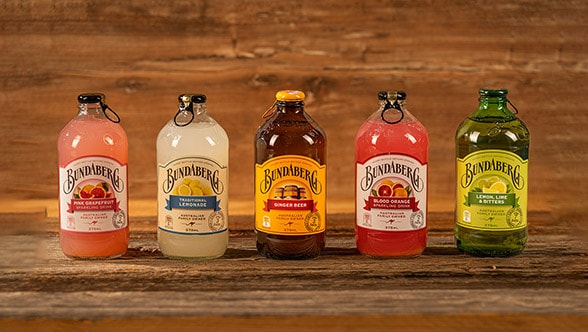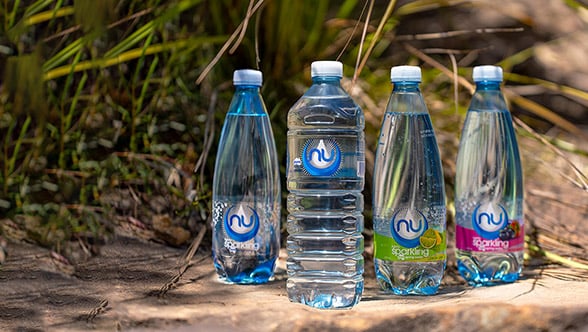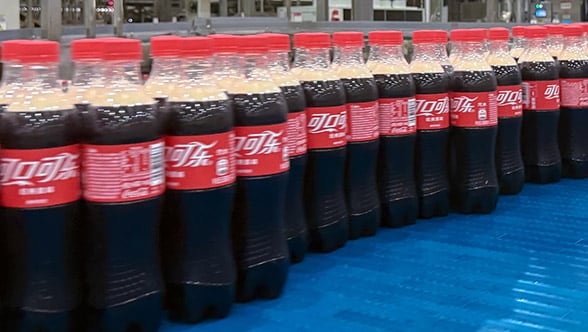
Shandies in multiple flavors, limited-edition seasonal products, different package sizes and country-specific labels: The beverage industry thrives on variety. But the same variety that grabs consumers’ attention on the store shelf increases complexity on the production floor. Because each additional flavor, new label or pack variant needs to be scheduled and filled – and efficiently integrated into existing processes.
More product variety, smaller batches, shorter reaction times: In the beverage industry, product and package changeovers are a significant factor for cost-effectiveness. Krones helps producers and co-packers improve the speed, consistency, and repeatability of their changeovers along the entire production line.
And so, all beverage manufacturers face the same challenge: “These days, if you want to operate cost-effectively, you have to fill efficiently – but it’s just as important to execute changeovers reliably and without errors,” says Martin Sporn of Krones’ product management team for lines and digitalization. Because high line speeds alone are no longer enough for day-to-day production marked by small batches, more frequent product transitions and the downtimes that go along with them. Fast changeovers have become essential to efficient, economical beverage filling.
A look at the possible consequences of not optimizing changeovers shows why this is important: Every minute that the line is stopped is lost production time, which reduces overall equipment effectiveness (OEE). And every manual intervention increases the risk of error. Therefore, fast changeovers don’t begin with the act of mechanically changing over parts but rather with ensuring that the next order, the correct parameters, the right product and materials and the necessary information about upcoming manual interventions are available at the right time.
Controlling the line as a whole
In actual practice, changeovers rarely affect just one machine. Depending on the order in question, machines’ mechanical parts will need to be changed over or adjusted, the new product will need to be selected at the HMI, printers and date coding devices will need to be adjusted, new materials must be made available, cleaning steps initiated and/or routes within the line modified. In addition, coordination needs to happen between operating personnel, shift managers, production planning and the warehouse – but also with the beverage production systems and the higher-level IT systems.
And it is precisely here that we see why fast changeovers matter for the entire line. When each machine is viewed in isolation, there is a greater chance of operator errors, wait times, double entries or unnecessary manual interventions. On the other hand, when the line is viewed and controlled as a cohesive process, orders and the underlying parameters, materials and any necessary manual adjustments can be perfectly coordinated to achieve a changeover that is efficient from start to finish.
Line Management
Less manual coordination, more system-based processes
Given these many and varied requirements, it makes sense to use software instead of relying solely on people to do all the associated decision-making and execution. Manufacturers can significantly reduce potential manual errors by using digital solutions to manage and, in some cases, automate the processes involved in SKU changeovers right down to the machine level.
To coordinate filling and packaging as an integrated process, Krones relies on Line Management as a centralized production control solution that works across all the machines in a line. The software brings together information from production planning, from the machines on the shopfloor and about material flows. It knows which order is up next, which machines will be involved, which route will be used and which products and parameters are required for the respective stock keeping unit (SKU). The result is that the many individual work steps involved become a unified, defined process. The changeover doesn’t begin when the last container for the outgoing batch rolls off the line. Instead, it is already prepared for and coordinated well in advance and executed in a controlled manner.
Coordination of order transitions: Line Management in the field
One of the primary use cases for Line Management is the centralized, system-controlled coordination of order transitions. Orders and bills of materials can be imported from higher-level systems or entered into the software directly. This is done entirely without paper-based work steps and the human error that often goes along with them. Line Management determines which machines and routes are needed, which product variant or recipe is to be used and which materials must be supplied. This information is then used to automatically set up the correct configuration for the respective order on the machines.
- Automatic parameterization is a significant advantage. Instead of needing to select programs and settings individually at several different HMIs, operators simply launch the order for the entire line once within Line Management. The relevant information is then transferred from this central point to the machines involved. Printers and date coding devices can also be included so that best-before dates, batch numbers or other packaging information are set to match the order.
- At the same time, Line Management also supports material flow. It is able to request materials so that they are supplied in time, account for any residual materials and end orders precisely when the tank is empty or the desired number of containers has been processed. A cleaning matrix makes it easier to choose the correct cleaning program or intermediate flushing in between orders. Additionally, operator guidance within Line Management indicates the manual tasks that must be performed during the changeover as well as important events, such as when no subsequent order has been set.
- Feedback regarding how many units were actually produced in a certain time or which materials were used is provided automatically, directly from the line to the higher-level ERP system and a connected warehouse management system – without the operating personnel needing to input anything manually.
This deep vertical integration of the software makes for a changeover process that doesn’t depend on individual requests or decision-making but is instead clearly defined and digitally connected to every system involved in the value chain.
Flying batch change: controlled transitions avoid full line stoppages
The advantage of this centralized coordination becomes especially clear when we look at flying batch changes. Here, the line isn’t emptied completely prior to starting the next order. Instead, consecutive batches are run with a controlled gap between them. While the last containers of the prior order are still being treated in the pasteurizer, for example, the first containers of the new batch are already entering the filler. In order for this concept to work, the starting and stopping points for all relevant machines must be precisely coordinated. Line Management does that, starting and stopping the machines automatically and thus controlling the gap between successive machines and preventing any mixing of the different batches. The advantage is clear: This system saves significant time between filling orders, assuming no lengthy CIP cleaning or manual mechanical changeovers are needed between the orders.
And that benefit is even more powerful when the production process is accurately tailored to the precise capacity of the tank, meaning that Line Management works with the machines to have the last drop in the tank be the one that fills the last container, thus completely eliminating product waste. The system involves not only the filler but also the upstream machines, for example to prevent too many containers or packs for the current run being fed into the system ahead of an upcoming changeover. In this way, Line Management makes a valuable contribution to resource-saving, sustainable production. Of course, this only works for suitable changeover types.