Process technology for the fermentative production of alternative proteins
To be able to continue to supply the world's growing population with vital nutrients and at the same time use the available resources sparingly, the nature of protein sources will change in the future.
The solution? Alternative proteins. This is because food of animal origin can be replaced with plant proteins, precision fermentation or cultivation of biomass, all of which provide equivalent products. And the increased efficiency in production means that natural resources are used more efficiently.
Krones supports food manufacturers in the production of alternative proteins – both during design of the process technology and when scaling up to a higher production output.
At a glance
- Process expertise and market know-how in the food and beverage industry
- Ideally coordinated technological solutions
- Economic conceptual design of the complete installation
- Energy-efficient process

A concrete example of the cultivation and replication of such proteins is biomass production. Here, cells are placed in a tank where cell multiplication is initiated. And this is exactly where Krones comes into play with its own bioreactor. The key factor: It was developed on the basis of the proven fermentation unit Poseidon from Steinecker from brewing technology and works with a circulation unit instead of an agitator. In addition, the recirculation unit is equipped with aseptic valve technology from Evoguard and a low-shear aseptic pump. Integrated in a sterile tank with steam or condensate barrier, cells can be cultivated or fermentations carried out.
Requirements to a bioreactor
| Homogenization |
|
| Mixing |
|
| Aeration |
|
| Feeding |
|
| Sampling | |
| Sterile environment |
|
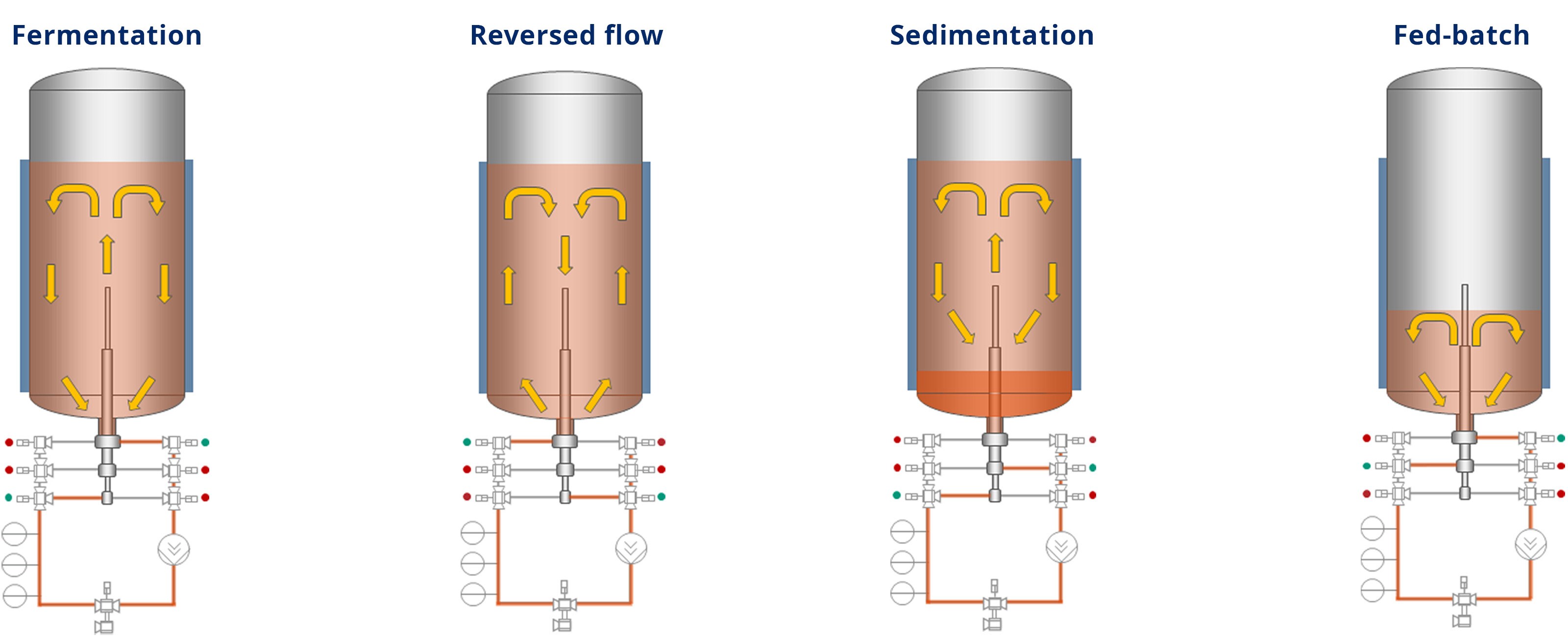
The recirculation of the tank volume under sterile conditions is the key task of an efficient fermentation process.
Dynamic fermentation
Recirculation for an efficient fermentation
Flexibility and scalability
- Available tank sizes: between 500 and 200,000 litres
- Prototype on a laboratory scale, validation and test capacities possible with partners
- Various outlet housings at different heights within the tank: are not only used as outlet but also as inlet
- Different flow directions possible (for homogenization, aeration, fluidized bed process or sedimentation for cell harvesting)
- Flexibility through pipe diameter dimensioning and adjustment of the volume flows in the pipe system
- Fed-batch or continuous mode possible
Cost and process efficiency
- Continuous mixing in a recirculation circuit: Use of a recirculation unit instead of an agitator
- Can be retrofitted into existing tanks
- Maintainability through easy accessibility of seals, field devices and motors
- Fewer spray shadows during cleaning for an improved cleaning result
- Representative measurement of process parameters by means of continuous flow through the field devices in the circuit
Process steps
Tank construction – From tank to bioreactor
Our expertise
- Manufacturing halls specially designed for tank construction
- Automated processes for tank dome and shell production
- Precisely coordinated work steps, carried out by qualified welders
- High-performance and program-controlled production machines for cutting, drawing and welding work
- Highest quality through a globally recognised and standardised welding and inspection procedure
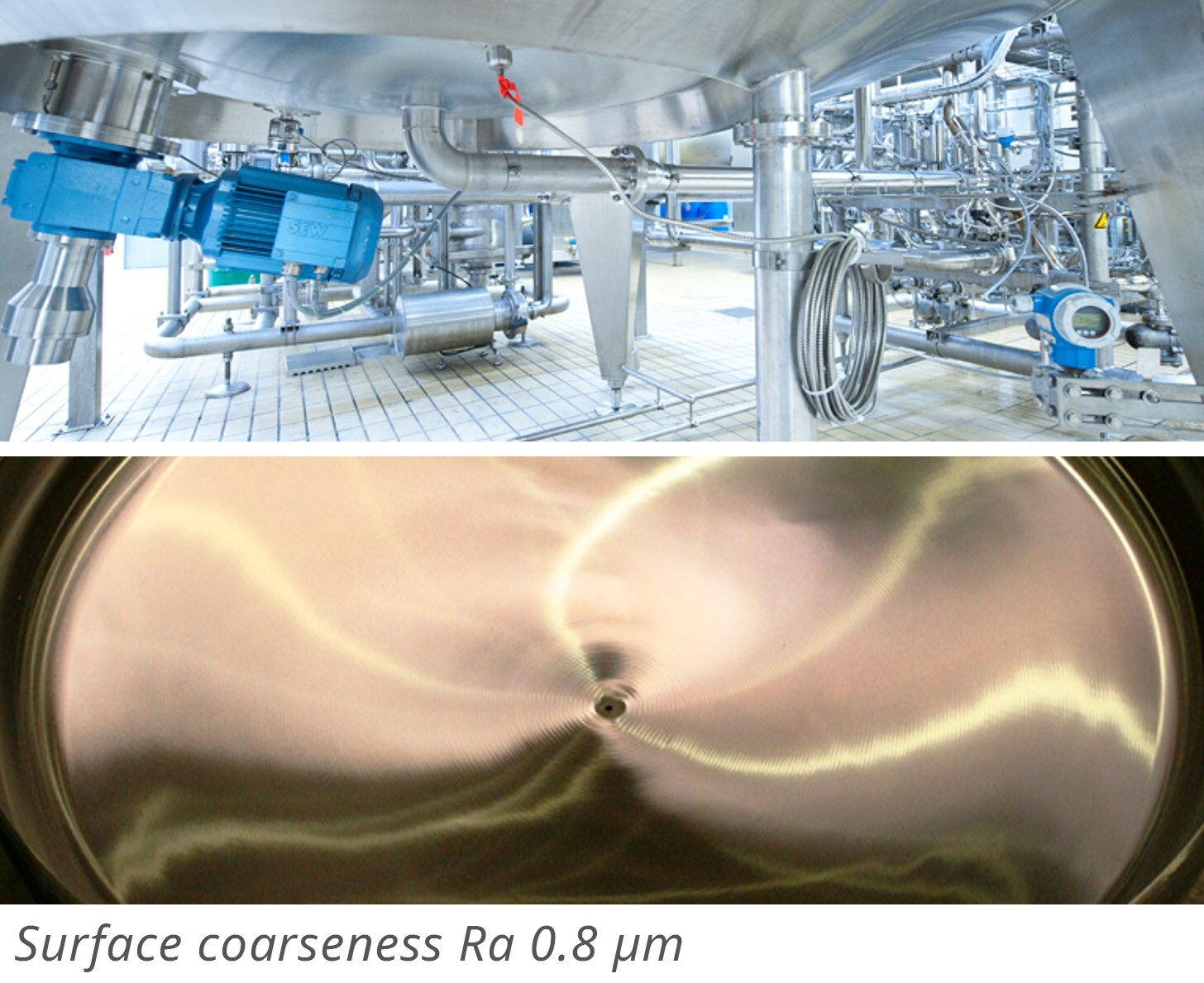
- Surface treatment with polishing and pickling solutions, including ceramic blasting of the outer surfaces
Benefits to you
Efficient solution for high production outputs
The use of a recirculation unit enables the realisation of high production volumes, and the costs still remain within reasonable limits.
Use of approved technology
The bioreactor was developed on the basis of the Steinecker Poseidon fermentation unit, well-tried from the brewing industry, that has already successfully proven its worth in practical use at numerous breweries.
Many years of experience in plant engineering
Decades of expertise in process technology are deeply ingrained within the Krones group. Especially, the expertise of the subsidiary Steinecker in the brewing industry can also be adapted to biotechnological applications. Customers who want to open up completely new markets in the area of vegan food alternatives are now also benefiting from this knowledge and are utilising Steinecker's proven
technology to do so.