
 Manfred Kaiser
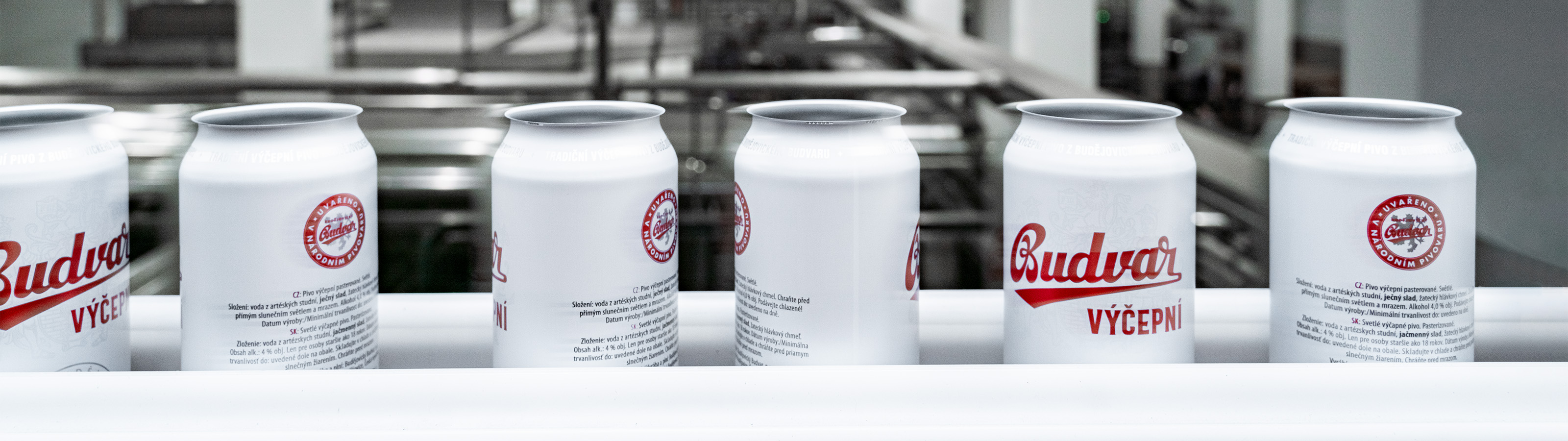
Twice in two years, the Czech brewery Budweiser Budvar has put a Krones line into operation – this time, a turnkey canning line.
For many decades, Budweiser Budvar did not use Krones filling lines for its beers. That changed for the first time in early 2020, when the Czech brewery put its first Krones line into operation: a turnkey returnable-glass line rated at 50,000 bottles per hour. Having been satisfied with that line, the state-owned brewery has once again chosen Krones – this time installing a turnkey canning line rated at 50,000 cans per hour.
Budweiser Budvar in figures
Filling lines
- Three glass filling lines, two rated at 30,000 bottles per hour and one at 50,000 bottles per hour
- Two canning lines for 25,000 and 50,000 cans per hour
- One kegging line for 500 kegs per hour
Output
- 2021: around 1.8 million hectoliters
- Of that, over a million hectoliters were exported to more than 80 countries around the world, with 450,000 hectoliters going to Germany alone
Installing a new can filling line was a top priority for the brewery’s decision-makers because cans are especially practical for export. Some countries, like South Korea, only import Budweiser in cans. But increasing at-home consumption of beer spurred by Covid-19 restrictions in the last two years has also been a boon to this packaging type, catapulting the brewery’s sales of beer in cans to nearly 500,000 hectoliters in 2021. For the sake of comparison, when the existing, smaller canning line was installed in 2012, the company was aiming for an annual output of 70,000 hectoliters.
The curious case of Budweiser and Budweiser
Beer connoisseurs know that there are actually two different Budweiser brands in the world. A legal dispute has been ongoing since 1907 between Budweiser Budvar, a Czech brewery based in České Budějovice (which translates to “Budweis”), and the American brewing company Anheuser-Busch, which has its own “Budweiser” beer brand. This is the situation right now: The American “Budweiser” can be sold under that brand name everywhere in the world except for the Czech Republic, Germany, and Austria. In these countries, “Budweiser” is Czech. And according to a ruling by the European Court of Justice, the US conglomerate cannot trademark the “Budweiser” brand in these countries. On the US and Canadian markets, on the other hand, the Czech Budweiser beer is sold under the brand “Czechvar” because Anheuser-Busch owns the “Budweiser” trademarks there.
Tetris – Krones style
The new canning line was installed in what was previously a warehouse for bottled beer. The process was not exactly easy since the space is divided up by pillars on a six-by-six-meter grid across the entire room. It was a challenge for Krones’ layout team, whose job it was to configure the line around the pillars, in a very tight space.
- As an example, the pasteurizer had to be delivered and installed in five segments – and just fits, to the centimeter, between the pillars.
- To fully utilize the space’s height for stacking pallets of empty cans, the brewery opted for a sweep-off depalletizer with a high-level discharge, which unloads the empty cans onto a raised platform that was specially constructed for the purpose.
- In addition, the line had to be connected to an existing pallet, conveyor, and warehousing system with 19,500 pallet slots.
“During the installation and commissioning, we also faced a number of unusual difficulties such as the coronavirus pandemic and the war in Ukraine,” explains Dalibor Čáp, capex manager for Budweiser Budvar. “In spite of all that, all of the vendors on the project succeeded in meeting our deadline for starting filling, March 1, 2022, right down to the day. For that, we would like to extend a big ‘thank you’ to everyone involved.”
Everyone on the project succeeded in meeting our deadline for starting filling, right down to the day.

The new canning line
- Pressant Universal1A sweep-off depalletizer with high-level discharge
- Cantronic empty-can inspector
- Contiflow mixer
- Modulfill VFS-C can filler with foam cleaning system and Modulseam can seamer, both in a cleanroom
- Two Checkmat FM-X inspectors
- Two Linadry container dryers, one upstream and one downstream of the can coding device
- LinaFlex pasteurizer
- Variopac Pro TFS packer for non-returnables
- Modulpal Pro 2AC palletizer
A conscious choice for a pasteurizer
“Integrating a LinaFlex tunnel pasteurizer was important to us, to ensure a shelf life of at least twelve months,” explains Dalibor Čáp. Since the existing, smaller canning line does not have a tunnel pasteurizer but rather only a flash pasteurization system, it is currently not in operation. Budweiser Budvar is now exclusively using the new Krones line. Its LinaFlex pasteurizer makes it possible to match the pasteurization units precisely to the different products and can sizes.
As it happens, this is also the first canning line in the Czech Republic to use a laser to print the fill and best-before dates on the bottom of the cans.
“The line’s efficiency is key for us”
To monitor their efficiency, the machines are integrated into the SitePilot Line Diagnostics system as well as SitePilot Line Management, the order and material management system. “The line’s efficiency is key for us. So we want to know exactly whether something is missing, whether we have enough of the product that’s being filled and enough packaging material, whether the fill date is printed clearly, and so on. The line management system tells us all of that,” explains Dalibor Čáp.
The brewery’s management also places a lot of importance on traceability. To that end, the pallets are marked with EAN codes, so they can each be assigned to a precise location in the high-bay warehouse. The brewery also uses the SitePilot Line Management material management system from Krones for the returnable-glass line that was put into operation in 2020 – and has been highly satisfied with it. This positive experience now has Budweiser Budvar aiming for an integrated concept in the form of an enterprise resource planning (ERP) system for the entire brewery.
“Outstanding results”
The line primarily fills 0.5-liter cans, but other sizes are also possible, including 0.33, 0.44, and 0.568-liter (pint) cans. The filled cans are packed into 24-packs, some of which are made up of 2 x 2 and 2 x 6 units. “The acceptance testing yielded efficiencies of 97.68 percent in the first and 98.34 percent in the second test, which we consider outstanding results. The technologies are all high quality. The machines got to work right after installation, and minor issues were resolved over the course of the subsequent two months,” says Dalibor Čáp.
The new canning line is now running in three shifts five days a week. The higher speed combined with excellent performance saves the brewery and its operating personnel having to work weekends, an advantage that’s not to be underestimated.
The decision to use Krones followed an official tender process. “As a state-owned brewery, we had to adhere strictly to the rules when choosing a supplier. Krones offered the most favorable terms and the better layout. And of course, we had already had a good experience with Krones and the returnable-glass line in 2020. That’s why we chose Krones again,” explains Dalibor Čáp. “We can give high marks to the service provided by both Krones’ Czech team and Krones AG in Germany. Throughout the implementation, our collaboration was close and friendly,” he says.
Throughout the implementation, our collaboration was close and friendly.
Expansion planned – to 3.6 million hectoliters
What’s next for Budweiser Budvar? “Our big task right now is to further upsize the brewery, to a capacity of 2.7 million hectoliters per year. We’ve already started planning work on this and are preparing to build a new brewhouse with three brewing lines. We intend to use coppers once again,” says Dalibor Čáp. “Right now, the brewhouse is at a bottleneck: It’s operating at 100 percent capacity, presumably in part because we have focused on expanding our fermentation, maturation, and filling capacities in recent years.” The brewery also intends to replace the two older glass filling lines with one or two new lines in the foreseeable future. “It’s true: We’ve been building non-stop. And we have set our sights even higher,” says Dalibor Čáp, who has been in management roles with the brewery for more than 20 years. “Parallel to all of that, we’re thinking about how we can bring our capacity up to 3.6 million hectoliters per year. But that will be the most we can fit on this brewery site.”
Traditional brewing
Budweiser Budvar was established in 1895, is entirely state-owned, and employs more than 650 people. The brewery site, which covers an area of around 120,000 square meters, is located at the northern edge of the city of České Budějovice, a popular tourist destination in South Bohemia. The brewery itself draws beer afficionados from around the world. Some 60,000 guests visit it each year, largely because of the excellent reputation of its lagers and its classic approach to brewing, which adheres mostly to traditional methods.
- The brewhouse features two copper brewing lines, each of which has a lauter tun with an exceptionally large diameter of seven meters.
- Budweiser also brews in accordance with Germany’s Purity Law, using only malt, hops, yeast, and water. More precisely, the hops used are exclusively Saaz hops from Bohemia, and not only that but the whole cone. In fact, it may well be the only large-scale brewery in the world to use the not-inexpensive whole-cone hops.
- Budweiser Budvar lets its lagers mature for a very long time – over 90 days, at cold temperatures of around two degrees Celsius in the deep, spacious cellars on the brewery property. “That’s especially great for developing its flavor, richness, and character,” explains Dalibor Čáp.
Budweiser Budvar’s flagship brand is Original Premium Lager. Other products include a bitter pale lager dubbed “Budvar 33”, Budvar dark lager, a low-gravity beer, and non-alcoholic beer. I What’s new in the portfolio are the Birgo-brand shandy, which comes in three flavor varieties and was developed in collaboration with the Czech-Italian mineral water bottler Mattoni, and the craft beer Bohemian Idols, which was developed in partnership with a small brewery.